This is the development journal for The Troll Contract, my point-and-click adventure game. I'll be posting artwork, graphics, design experiments, production notes and other progress here as the game comes together.
November 2026
"The Troll Contract"
So, here I am in the thick of World Design.
And I was thinking about that.., not about the world or the designs, but rather of the act itself. Please indulge me for a moment while I point out some of the basics:
Working on 'World Design' is just a fancy way of describing the activities of a seriously baked-in feature of our collective psychology. -Because we all do it, all the time, imagining possible realities.
For instance, we might wonder, "I've got a Big Choice to make. Let me imagine the ways it can all go horribly wrong. What needs to happen for it to go wonderfully right?" That mental exercise is, at its base, an act of world design.
We may think, "Oh dear! People are giving me subtle looks. They're whispering behind my back! I wonder what horrors they are planning..?"
People are endlessly creative when picturing plausible routes to devastating outcomes. We're really good at that one. People lose sleep over it. -And perhaps survive catastrophes because of it.
Now we humans, being marginally elevated beings, have discovered a way to harness that primal risk/reward assessment brain loop, and direct it to entirely different ends. Toward Invention and Entertainment! What a hijacking!
Though, one might easily argue that Invention and Entertainment are actually perfectly natural expressions of the same thing, simply running at the next level of complexity. It's still survival behavior. (Invention is obviously advantageous, and Fun is our bio-evolutionary answer to the problem of making sure we practice and learn difficult to master behaviors which might be of future benefit. -Of course, our automatic drives are not terribly discerning about subject matter, (how many flappy birds does one really need to click in order to succeed in the world?) but the general idea is that novelty in our environment might lead to dangers or opportunities, and so to ensure that we explore and learn, our brains have a, "Make it fun!" circuit which gets engaged.)
Shared stories are attractive because mythological language binds cultures together, because hero templates teach how to live, etc. Stories are vital in a multitude of ways as is well discussed across academia. In any case, when it comes to deliberate fiction writing, the exercise of imagining possible realities expands beyond routine survival projections. Unlike obsessively wondering about the local gossip, when we author worlds, we take the same tools and push beyond the standard lizard brain stuff and really formalize the process. My god, do we formalize it! -We take extended notes. We draw maps. Whole documents are produced. Books!
And that's exactly where I find myself again. -The long form note-taking state is one I don't often occupy. Not at this level of industry. It's multi-dimensional, for goodness sake! With world design, you're not just taking a character through a linear bit of time and experience as one might with a bit of prose. You're not just tracking, "He said, she said, what happens next?" Rather, with world design, you're asking those same questions but from orbit. In a time machine. -With the ability to zoom in on granular details. All while allowing yourself to be be excited by the, "Oh, Oh! And then..!" moments.
I've not had a reason to invest this specific kind of effort in a long while. Thieves & Kings, obviously required a lot of it; I spent several years writing and pushing ideas around, sketching and painting, fleshing things out before ever drawing page one, panel one.
Stardrop and Jenny Mysterious, both being set in the 'real' world, needed less nuts and bolts foundation building. The world was already done. I just needed to walk around and take pictures or pore through archives. Somebody already wrote the history book. -My input creative effort was rooted in character back stories, establishing sets of rules and narrative mechanics. I never really needed to come up with make-believe stories about who built the town clock or how space ships worked. (Though that changed somewhat as Stardrop progressed).
Stardrop, even as its narratives moved into story areas requiring heavier construction on big, unseen systems, remained largely ad hoc, accumulated. "Kytanna made this throw-away comment in a strip I drew five years ago and I went ahead and drew it because it sounded cool.., but now I have to actually reference what she said. And I have only a vague notion of what a, 'Seventh House of the Knustave System' actually is. Ugh! I need this strip done by tomorrow morning. I have to write something that fits without breaking anything. I need to do it fast!"
That style of 'seat of yer pants' writing, by the way, while heavily criticized by approximately half of any given writer's discussion group, is not a system with zero reward; it forces you to remain nimble, (who doesn't like being nimble?), and to constantly re-read and stay coherent with the entire body of work to date. -The wider canvas then often reveals itself in a manner which in retrospect seems curiously obvious and inevitable, like it really was there the whole time. It means as an author I get to discover and revel in the call backs and discoveries along with the readers. On the downside.., it can be exhausting; writing becomes a bit like being in a roller coaster car with a broken safety bar. (Has that ever happened to you before? "Is this thing locked down properly..? Oh jeez we're moving! Seriously. Has this ride been properly maintained since it was built back in the 1970's..? I heard that a kid lost a tooth last year...")
Ahem.
Beyond those immediate concerns, world building on the bleeding edge can also lack a sense of intention from the start. Obviously. -Readers appreciate an authoritative voice (rather than one screaming from the top of a carnival ride.) -I always felt somewhat guilty about not having done the work to set everything in place with Stardrop before I started drawing. I couldn't shake the feeling that I was cheating. Though, in truth, there's never any free lunch. The work WILL be done (if the story is to be any good), it's just a matter of how and when. You can do it all at once at the beginning, or you can make regular, (interest heavy) payments every couple of weeks -at the 11th hour before Comics Guido knocks at your door demanding the next set of pages.
In my defense, Stardrop was only originally intended to be a humor strip, so the world design was a distant secondary concern at the time. The focus was on the stuff I had researched obsessively; the characters and their behavioral patterns.
Anyway... This new project is very different; By its nature, a video game needs to have a great deal of working parts all figured out and running smoothly together in advance. -Certainly, I do intend to create a series of different games all set in the same world, so there is going to be an episodic nature to the whole project. But unlike a comic book or comic strip, it becomes much more difficult to borrow against the future in terms of, "Trust me. I got a plan!" while only having a vague notion of where things are going.
You can't just draw a cliff hanger and figure, "Phew! Done. I fed the tiger. That gives me time to work out what happens next before it gets hungry again." With a comic strip schedule, the most important thing is getting the work into the editor's in-box before he sparks up his computer in the morning. That approach doesn't work with computer games; that next scene, ALL scenes in a non-linear world, need to be fully realized in advance, cued up and ready to hit the screen in exactly zero point no seconds.
So..,
Let's see what I've got here I can share...
I have some neat paintings of Osbert's mountain top world.
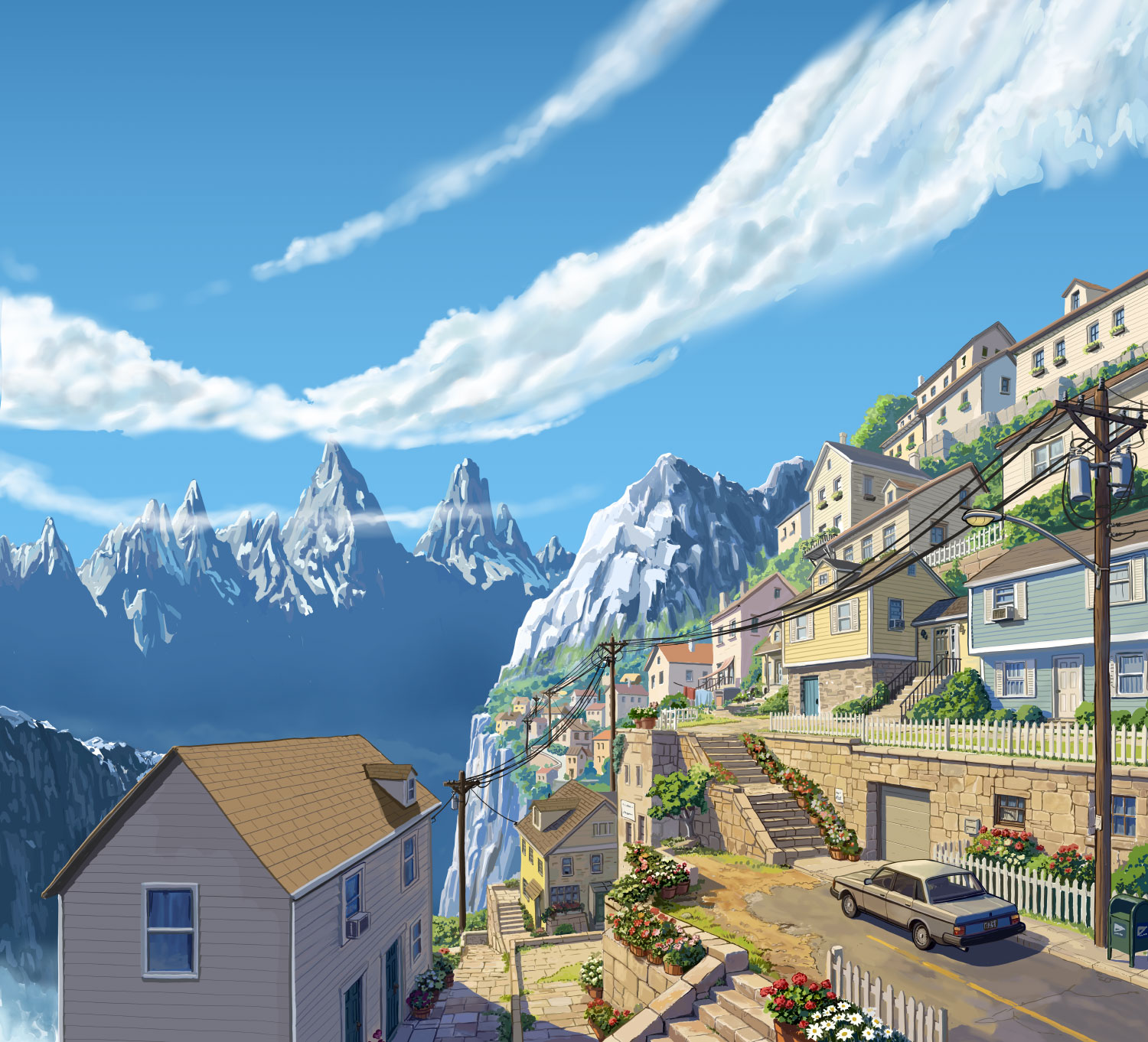
Painting is both a great way to flesh out a world during the design phase while at the same time producing working assets for the finished product. I pity the authors who can't draw. It seems like a huge limitation. -I've read accounts of writers and their forged relationships with fantasy illustrators, going back and forth on details, trying to get one or another image just so. -Of having publishers huffing in the background, "It doesn't matter! We just need it done! Make it pretty!"
I don't think I've seen a single Jim Butcher book cover where Harry Dresden didn't look completely wrong. How does an author survive like that?
In my case, I'm not directly tasked with drawing the main character. Not for this particular project. Osbert Wellington is never going to be in frame. How weird is that? That's very new for me. It's all player POV. -So all my work is currently focused on the mountain top world of Evan's Pass where the action takes place.
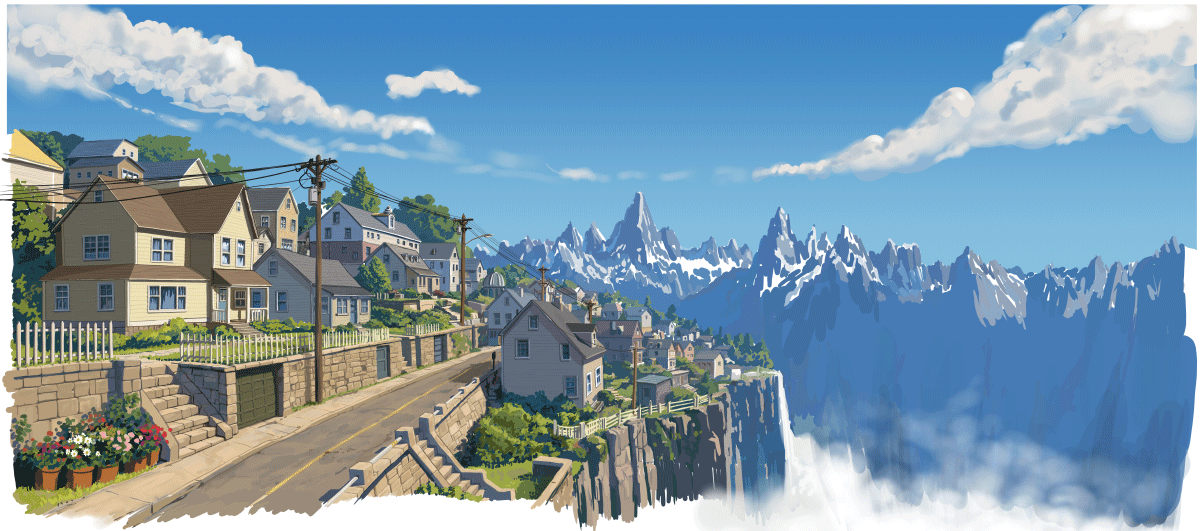
I've included here some new pictures of that world, Osbert's house and his surrounding neighborhood on the very edge of the caldera.
This next one (below) is a wide view attempt to capture the whole town in one shot, cupped at the top of the mountain by ancient remnants of blast crater walls. -You can see Babeltec's new technology factory squatting in the background. (I've included larger versions of these images so you can zoom in a bit.)
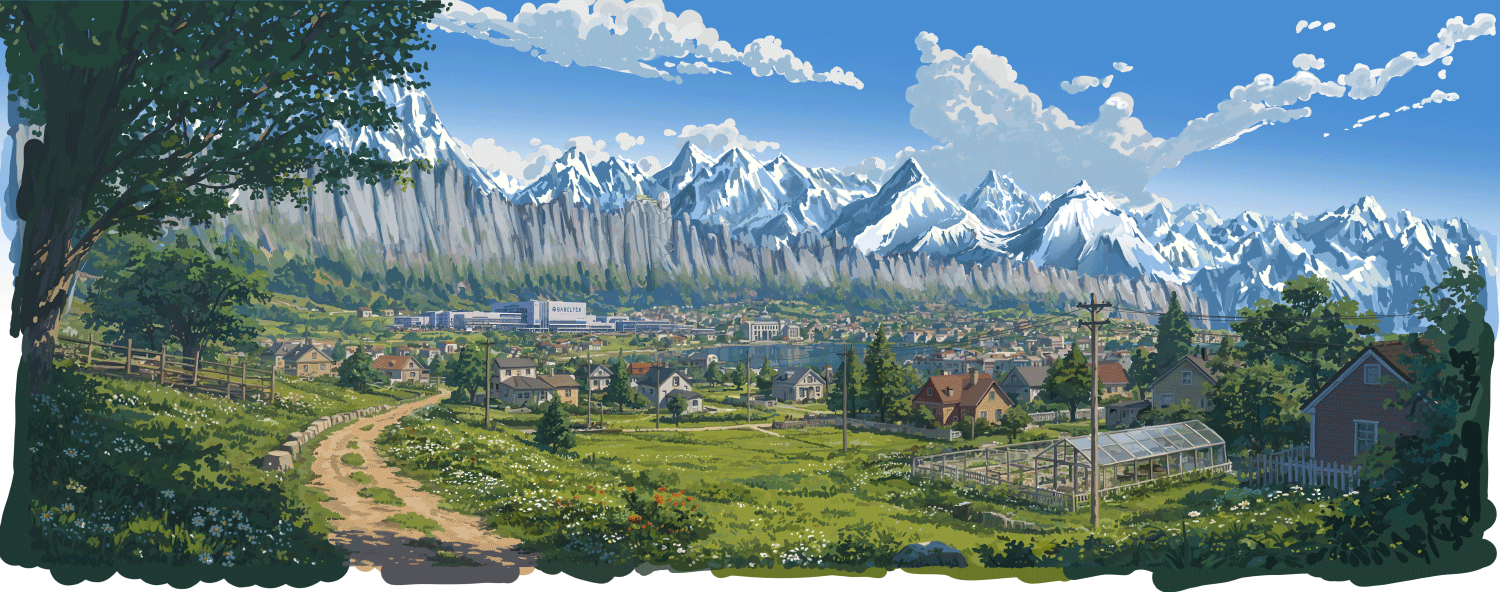
Oh. This is something I thought might be interesting to share: I've decided that interior, close-up shots will be constructed with black ink outlines, like my regular comics work, whereas long shots outdoors will have softer edges, suggesting light diffusing atmosphere between viewer and subject matter. -Which, may not have been the brightest plan; it takes significantly more work to define objects without the aid of hard black lines one can fill in with color, but.., I think it looks cool, so that's how I'm going to do it. (Working in full color for everything is a push out of my comfort zone, and that keeps me alert. I'm getting faster, anyway. I'll certainly need to in order to keep up.
I had a bunch of other thoughts I wanted to include here, but my wife insists that nobody has the time to read a million miles of text in single post.
"Life is busy, honey. Don't overwhelm people. -At least break it up into sections. You're all over the place."
"Yes, I'm all over the place. It's World Design, hon! It's non-linear by default. I mean, check it out: I have this whole infinite closet dimension I'm working on. I had to come up with 1000 different objects, just for starters. I have a list. They all need drawings. And there's this power generation system I worked out. They run water down the side of the mountain! It totally works! -I was worried about how a town on a mountain top would get power. Run lines all the way from the coast? No way! That's nuts. That's a maintenance nightmare. Think of trying to fix a power line after an avalanche. -But hydro electric? Even from a small lake.., I looked it up. You wouldn't believe how much electricity you can generate from two miles of falling water! Also I just wrote an interview with the villain of the story. -Well, he's not really a villain. He's more like-"
"Honey. Hon. All over the place."
She's right. I'll keep it tight. -I'll post some more stuff in a bit.
Cheers everybody!
October 2026
Hello!
It's been a while! Thank-you for your patience. Updates incoming in both quantity and variety!
Fist of all...
"Print & Ship Comics" is -DONE-.
The back-end development of that series, creating a point to point email list was a mammoth undertaking, and I'd been ready to invest the next few years in documenting the amusing goings-on of the local UPS Store where my darling wife works.
Or rather.., worked.
Oh man! Due to ridiculous circumstances quite beyond her control, she lost her job. From a writer's perspective, it's a fascinating story which boiled down to this; The boss's new girlfriend took a disliking to my wife and things went all "reality TV" dynamics for a while. -But that's certainly not the kind of story I want to draw, so.., onward and upward!
Indeed, it was the boost she needed to start her own print business. Sometimes the world lays dynamite beneath our feet when we get too comfortable, when personal potentials are not being met. -Which applies equally in my case as I realized that my fascination with the retail world was really just a fascination with the woman I'd married. -Which makes obvious sense in retrospect; the sparkle was simply not as sparkly without her reported daily adventures with oddball customers.
I've got a couple of unfinished strips which I found myself looking at, thinking, "These are good. This one is about a customer who took a poop on the floor! I mean.., wow! That actually happened! -I could keep this comic train going; I've collected enough stories for years worth of strips. We all know that Momentum, good ol' Stick-To-Itiveness is all you need for a payoff, but... Without her in it..."
-Perhaps if the project had started earning a lot more income a lot more quickly, I'd have a different opinion, but webstrips, even those crafted for a specific audience, an audience which responded with enthusiasm, just doesn't inspire those same people to spend any money. After all, beyond your phone bill, everybody knows the internet is supposed to be free, and webstrips are part of that freedom. That's the common opinion we have apparently settled upon as a species, and you know what? That's totally fair. If I am being perfectly honest, I can't think of a single webstrip I've given a dime to over the years despite having read hundreds of them.
See? It's Karma!
But that's only half the story, and certainly not the interesting half...
I am one of those creative types both blessed and cursed with being able to only really pour energy into something I am enamored with. -While this can obviously work to significant benefit, (such works transmit feelings to an audience in a way nothing else can and, I would argue, in a way which differentiates the Good Stuff from everything else), the downside is that it also makes it difficult to clock in and out of work like a damned adult. -I am quite proud of not being a kid anymore, of holding responsibilities, of being the guy people turn to in times of crisis.., but whenever I've tried, really tried, to work on something that I don't intimately care about, the work just gets.., thin. It lacks spark. People can always tell.
Plus.., there was this other creeping feeling. Even as enamored as I was with my wife's life behind the retail counter, even in the thick of enjoying drawing silly strips about silly customers, I was telling myself, "This is a great little project, because once all the heavy lifting is done, it's the sort of project which will allow me time to focus on the thing I REALLY want to work on. The thing I know I'm supposed to actually be doing."
Yep.
If I'd been Listening and not avoiding Coming To Grips, not making excuses...
Well, here we are.
Some background:
Comics are dead. Well, they're not dead; there will always be comics, (pictures in a row which tell a story? That's not going anywhere), but the medium and market have evolved in such a way as to make them a barely/non-viable career path, with the few survivors fighting, (often viciously) over the remaining scraps.
Let me share a common interaction:
"Oh, man! I read your last strip! That was perfect! I love these!"
"Thanks! Are you going to subscribe?"
"Oh no! I'm not PAYING for it." (This reaction is automatic, like a bee sting, and therefore honest).
You can make all the "Price of a cup of coffee" arguments you want, but you simply can't fight a market force like that. That stuff is baked in. Psychologically speaking. So what do you do? Well, you can only bend with it. You can perform community build-outs of one sort or another. You can post daily FaceBook videos, reminding people that you're also an author. You can license content to umbrella organizations which want to decorate their corporate entity so that mandatory newsletters actually get read. All of that can be done, certainly, but then you're building something other than stories. Fun fact: I spent more time creating and tuning an in-house email server able to circumvent spam filters in order to deliver comic strips to the people they were made for than I did actually drawing them. (And yes, there was some pushback from people who hate spam, but I've also been growled at by comic shop owners in the past as well. You can't please everyone and you have to expect a fight or two if you want to be in the media biz. -And anyway, in both cases it was less than 1%, and their wishes were immediately respected as I duly removed myself from their lives. However the, "These are great! Please send more!" signal far outweighed in the whole dynamic.)
Anyway.., it doesn't matter now. Plus, the real world US/Canada tariffs hit. Oh my! Poof. There went 90% of my book sales. Yes, Universe! I'm listening. (Sometimes dynamite has to be placed beneath one's feet to send the message; "Stop clinging, fool! You've got new challenges waiting.")
Independent comic books, for a unique and shining moment in print history, were a profitable venture in and of themselves. It used to be that every young person participating in Western Culture would at some point during their days of youth, visit a Comic Shop as a paying customer. Back in The Day, everybody I knew had read at least some of the big titles, knew the stories, had favorite characters. Had opinions. -Knew enough to engage in popular discussion. Comics were a medium with a heartbeat. Reading comics was a Normal and Expected part of Culture. That has changed.
Today.., I don't know a single person in my daily life (present company excluded), who reads comic books. Manga, yes. Oh.., kids read manga! However, manga is a very different animal. After many years I finally realized, "I don't make manga. I don't even think I can make manga. Whoa." -I could describe the many differences between Western Comics and Manga; I can talk about the varying production philosophies, the distribution systems, the audience reading patterns.., and it is certainly an intriguing discussion to be had, but the long and short of it is this: very simply, I am not Japanese and never will be.
The phenomenon of Westerners like me participating in culture in a meaningful way by peddling home-spun comics is, by and large, over.
And yet Culture itself isn't over. Media is pounding along as strong as ever. Paper may be dead, but everybody has a screen. I mean.., EVERYBODY has a screen!
So what are people today actually, acutely engaged with? (And more importantly, what are people willing to pay for? What do they expect to pay for? What do they WANT to pay for?) When you consider a young adult audience, at the mere mention of a given story or character, what will perk ears throughout the room? What touchstones are now part of Normal and Expected Culture?
Waaaay back in the 90's when I first started drawing comics professionally, I'd earn scowls of confusion when I admitted to my peers, "I don't actually read comics." -Of course, I knew who Spiderman was and I'd read plenty of Calvin & Hobbes strips... And I'd excitedly ask if they'd seen any of the obscure comic shop items which had caught my interest. But for the most part, I was driven by a fascination with the possibilities of the medium rather than the very short list of content I was interested in.
Well...
I don't actually play video games.
~~~~~~~~~~~~~~~~
FAQ:
1. I'm not interested in Mario Cart FPS Triple AAA Hand-Eye-Coordination pop-the-dots games. I don't care about Minecraft. There's nothing specifically wrong with any of that material, (aside from the addictive qualities, perhaps). It just doesn't interest me.
I AM however, interested in odd little titles where stories happen, where stories are the primary focus. Specifically, the kinds of games people talk about excitedly, ("Oh! Have you played ___?") -Games which, as it happens, are also theoretically possible for one guy to make by himself. And, weirdly, despite all the vast variation, games which have never really scratched the itch where I think they should.
2. Video games are made of two things; art and code. While I am certainly a nerd who knows his way somewhat around the back end of a website, I am by no means a coder. However, (as you may have heard), here we all stand at the crest of the Wonderful and Terrifying Ai future, where certain barriers to entry are rapidly evaporating.
Through purely unrelated initiative, I spent a lot of time over the last couple of years learning all about the bold new Ai future tech on everybody's mind. (If it scares the living daylights out of you, you can either howl and cower in denial or you can lock eyes. I chose the latter). So I built a machine with some heavy duty graphics card mojo which allowed me a lens through which to observe and tinker with the Big Change in real time. After being woefully unimpressed, (and damned relieved, if I'm being honest) with the artistic 'capabilities' of Ai, I also realized that the technology had other, actually useful, applications. One being that with enough work and learning on my part, my chugging infernal desktop machine has proven a satisfactory game code factory, enough to put my little ideas into the realm of "Yeah, that's entirely possible."
3. Ai and artwork. If you don't draw/write it yourself, it's going to be soul-sucking trash. Full stop. Already, even with the top end model output, I cringe with near pain when I hear an Ai voicing a YouTube video, reading from an Ai generated script. I may well be on the leading edge of that evolving perception, having spent a life tuning myself to media of all types with a degree of tunnel vision attention. (I had to stop reading National Geographic when they downgraded their typesetting to 300 dpi), but regular people are, often unconsciously, developing a sense for the difference between "Soul and No Soul".
So, I am writing and drawing everything (all the human-readable stuff) myself. Jeezuz. I can't believe anybody really thought machines would be able to replace artists and authors! -In any meaningful way that is; if you want to live in a world of elevator muzak and lowest-common-denominator eye candy, then sure, Ai is coming for your job.
But honestly..! Ai is hopelessly bad at art. -And I'm not just talking about the little open weight silicon devil box under my desk; I'm talking about the frontier, trillion parameter models which dropped ten minutes ago and you have to pay for per token. They are all, without exception, really, REALLY bad at understanding the vital subtleties which make the difference between earnest connection to another human being, and infuriatingly pretty-but-sterile wallpaper. -And until somebody finally stuffs an Ai brain into a fully autonomous body which can independently live, learn, explore, get hurt, win some, lose some, out in the real world.., that situation won't change. Both intuition and, as it happens, the Ai architects themselves, attest to this truth.
But beyond both math and gut feelings, I can further report on this after trying in earnest to train a machine to be a helpful ink and paint assistant which might take on some of my more mundane and repetitive (and back pain inducing) tasks. Wow. Now THAT was a colossal waste of time! -Though, as said, it did serve as a hands-on learning exercise so that now when I tell my peers to settle down and stop living in fear and loathing of the advancing machine overlords coming for their notepads, I speak from direct, good faith experience. It is simply not going to happen. I can get into the deep reasons, but the immediate take away is this: getting an Ai to take the vision in your head and put it on paper is like trying to direct, from your back deck, a severely mentally handicapped individual through the construction of a swing set or a garden shed using only swear words and vigorous hand gestures.
It's bloody near impossible, and by the time you achieve it, you realize you could have done it yourself with half the sweat and none of the aggravation.
4. What about..?
This project is a cutting-my-teeth effort. If it works the way I hope, then in the future we may expect to see some old favorites.
5. Samples...
As with any story appearing in any medium, for there to be lasting value or depth, one must first do the work of world-building. -When it comes time to paint the scene outside the protagonist's window, you first need to know what is there, why it is there and how it came to be there. That doesn't happen without Back Story.
This very simple truth represents the tremendous primary challenge all successful authors must navigate. There's no faking it; the audience can tell if you've skimped just as they can tell if you've put in the Work. -And that Work, as heavy at it is, pays in kind; the more you dig, the more information comes to the surface, providing its own direction and prize value; until you've gone down the rabbit hole and dug into the third and forth intersections, your fancy idea doesn't really begin to sparkle.
Back Story in my case often appears as a jumble of notes and sketches and disembodied records which would make little sense to anybody other than the author. While stories are linear, the worlds they inhabit function more like spiderwebs; a story is like the 2D shadow cast by a 3D object. (Or, more correctly, a 3D shadow cast the 4th dimension). However, some of that can be assembled into early packages which provide peeks and windows into the author's mind. The following text is a short example I put together toward that end:
"The Closet Troll Contract"
Meet Osbert Wellington. He is 13 years old.
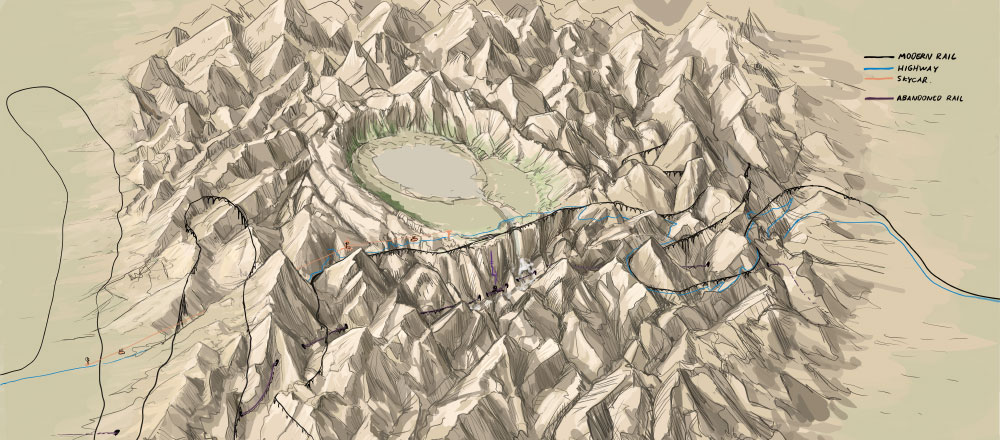
Osbert lives in the weird little town of Evan's Pass, (pop 12,000), nestled among the crags of Mount Evans, a flat topped monolith hidden among the vertebrae of the national backbone. The scenery is replete with plunging chasms with rushing rivers at their bottoms, their mists a perpetual fog from which rise the wedges of mighty granite teeth jawing at the atmosphere above.
Despite Evan's Pass sitting at a record altitude, the surrounding peeks are higher still, cutting an hour of daylight from each end of the clock with their looming shadows. -However, once the Sun does finally blaze over the morning ridge, the town is bathed in a warmth and clarity like nowhere else on Earth; even in the Winter, a modest autumn jacket is all you really need, and that's way up in the mountains! So, "Short days but gentle Winters. It's a give and take." Nobody complains except those who are going to complain no matter what you do, but there are cranks the world over. Evan's Pass is no different in that regard.
On the Western side of the mountain range is Mason City, a modern seaport metropolis. To the East stretch the Great Plains and sprawling agricultural projects, farms, homesteads and the small city of Tupperton. Historically, those farm lands have always been lush and rich, and thanks to the vigorous nature of the folks settled there, productive. The challenge then being, "How do we get our tons of farm produce to the port town on the other side of those bloody awful mountains?"
The road over the mountain, especially in the early days, was steep and treacherous. It took two days of hard riding to traverse, which meant a night spent camped out on the high part in the middle. Through a stroke of fortunate geography, (discovered by a brave trader and adventurer named 'Evan'), the high part in the middle actually provided surprisingly well for tired wagoneers.
A result of constant high and low pressure air masses caught between ocean and land, together combined with the particular wind breaking shapes of the surrounding peaks, made for a seemingly miraculous bubble of calm set in the very jaws of the mountain. A protected port of sorts, in the midst of a hundred million years of igneous turmoil.
After reporting his discovery, wagon trains from that point forth at the end of a day's blustery climb over craggy roads and nerve wracking switchbacks, would attain the plateau to find spreading before them a rolling green carpet of flatland, replete with grazing animals and tufts of forest spotted here and there, islands of trees providing shelter for smaller creatures. And most astonishing, at the center of this unlikely paradise, a clear, oval lake shone like a mirror reflecting blue sky above and the majestic peaks surrounding. -A testament to the creative alchemy of Planet Earth or, as the boffins at Evan's University reported, some frightful astronomical event in the distant past.
In those early days, traders would pitch their tents upon the plateau, sleeping safely beneath an infinitude of stars while soft breezes played through the night grasses, in the morning arising to wash away the previous day's grit and road dust in the crystal waters of the lake, spreading their clothes afterwards on the rocks to dry. -And once that was done, the travelers would realize lunch time was upon them, and by gosh, that fresh mountain air gave one a mighty appetite! By the time everybody had their boots and wagons finally tied up and properly ready to resume their journey, it was pressing into the afternoon, far too late for departure if one wanted to arrive in the city before nightfall. As everybody knew, travel in the dark on that god forsaken trail was tantamount to suicide. And so, every traveler through the years without exception discovered it to be the very simplest of rationalizations to stretch their journey an extra day. -Or two, if business was not pressing. Indeed, many found it difficult beneath that bright blue sky, standing in those soft green pastures overlooking that enchanted lake, to recall exactly what the anxious hurry was all about back down in the real world.
It was inevitable that a settlement should take root.
Olden days passed, leaving railways and roads, and even a briefly famous zeppelin port in its wake. Inns and homes sprouted up, shops, churches and school houses, town squares, town halls, and a proper official post office to pin it all in place. All of it spread prettily enough, spilling from the flat parts of Evan's Pass and clear over its edges, clinging to carved cliff faces in a colorful display of civilizational growth. A coral reef in the sky. And above it all there loomed the Gothic fortress set between two high crags, with its peculiar half-egg monument; the University Observatory. Additionally today, there was now the huge modern glass and white beam structure of mighty Babeltec...
As it happened, the arrangement of land in that spot lent itself to more than just the convenience of traders and settled mountain-top citizens. Recently discovered was a quality inherent in Evan's Pass specific to its altitude, making the town of particular interest to researchers of various stripes; geologists, physicists, geneticists, pharmacologists, biologists, botanists and, more recently, vested industrial concerns.
Quote: "Gravitational Time Dilation: According to General Relativity, time moves faster in higher gravity as demonstrated by the famous, "Double Slit Experiment" -when removed from its traditional bench top presentation. Rather than lying flat, a laser is instead mounted to an upright wheel and spun end over end. It was noted that in addition to the already scientifically unsettling patterns produced when shining a light through a pair of slits, yet another weird phenomenon is revealed: "Wait. The pattern changes? But nothing is different except the orientation! It shouldn't be changing. Why is it changing?" -It turns out that the frequency of a light wave at the top end of the apparatus is slightly shifted compared to the low end. Even though the difference is incredibly small, it accumulates a different amount of phase due to moving through regions of different gravitational potential."
Put simply.., Time moves more quickly at your feet than it does across your scalp.
Now, like so many intriguing facts produced by the sciences, this particular example holds zero practical value for the average person; the effect is microscopic after all, serving as little more than a spritely observation useful during Trivia Night down at the pub. However, in the present day of advanced computer chip manufacture, with trillions of dollars invested and competitors racing to produce ever smaller and atomically more complex circuitry, this particular microscopic nuance, it was realized, mattered a great deal. A very great deal.
The immediate consequence being that Evan's Pass, which happened to be situated at precisely the correct altitude for that particular quantum effect of interest to become apparent, (the only altitude, in fact, the sweet spot being measured in just a few meters), with Evan's established infrastructure, population and cargo routes, all ripe for serving the global scientific and industrial community without anybody having to go to the fantastic expense of carving out new facilities on other mountains elsewhere in the world.., the small town became a big town in very short order.
The university, for one, saw an influx of global interest. The brightest minds from an array of sciences flocked from all ends of civilization, with their suitcases and trunks full of equipment, hopeful that the next great feat of human discovery lay just a few quantum phase differences away in that postcard mountain village. New wings of the faculty were constructed to contain all the excitement, breathing sparkling life into the once obscure little campus.
(Evan's University had begun as a modest night sky observatory nearly a hundred years earlier, being one of those few spots in the world where the air boasted such remarkable clarity that it became widely considered as good as or better a site for stargazing than even those of Mauna Kea or Peru. Further sweetening the arrangement, Evan's astronomers appreciated not having to trek up and down miles of isolated Peruvian mountain trail just to peer through a telescope eyepiece. An Evan's scholar of the stars could look forward to a fifteen minute walk back to the comforts of cozy civilization at the end of a long night, rather than a dinner of micro waved spaghetti and a lonely cot in a concrete bunker).
Osbert Wellington's father was one such man. -Keen on the quest to map the stars, and only tangentially literate in the newly important matters of quantum physics and cutting edge microchip manufacture which had crowded into his once tidy life.
Osbert's mother also worked in academia, teaching stellar astronomy. She and Osbert's father were the result of that statistical truth; people are most likely to meet the love of their life at either school or at work. Since in their case it was both, one might assume their relationship was doubly solid.
Theirs was, however, also in keeping with types, a relationship filled with distraction. As both parents were fascinated with the universe Out There, the desire for a second child down here on Earth, (a brother if possible, as Osbert often suggested and very much desired), was a goal only halfheartedly pursued. After a few seasons of 'trying', talk of bunk beds and second bedrooms became less frequent and eventually petered out altogether. When his father installed a 'weekend' telescope in the spare bedroom, Osbert resigned himself to the dreary reality of being an Only Child. -One with a fair bit of time on his hands; having two obsessive astronomer parents meant little time was found for such mundanities as softball games or trips to the public swimming pool.
-Which led in large part to the very events set to entangle Osbert in their grip; events which while casting him as a figure of central interest in this story, should certainly not befall most children. Not those whose parents paid more attention, at any rate.
We are speaking now of things that go Bump in the Night.
We are speaking of Trolls...
~~~~~~~~~~~~~~~~~~~~~~~
This is the working set of Osbert's room:
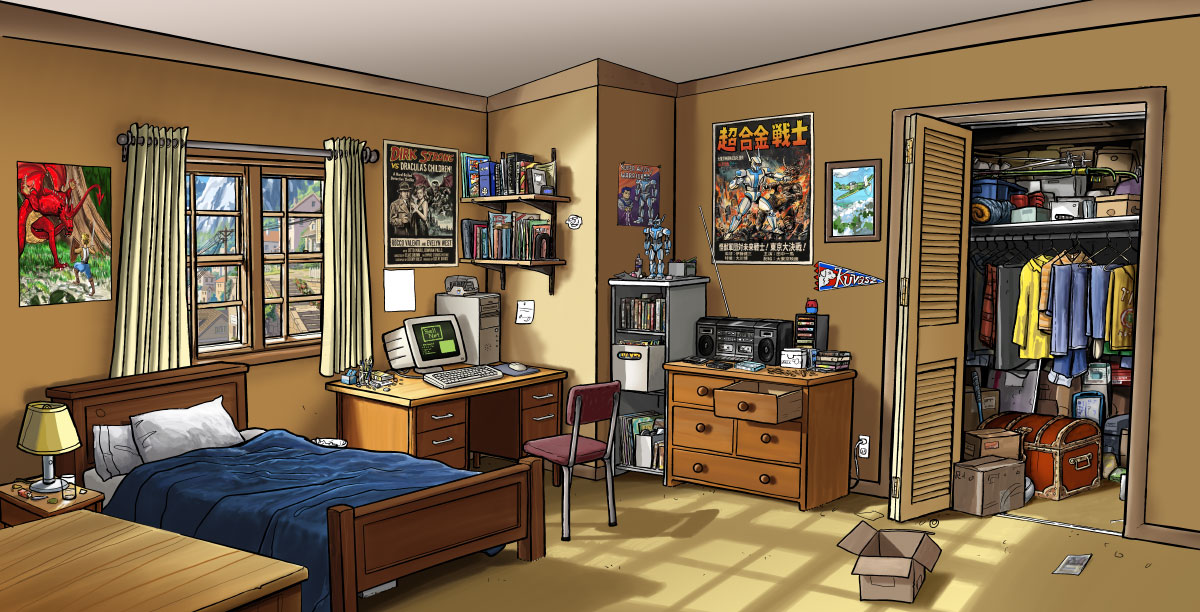
There's still some stuff I'm working on here in this scene. A bunch of the objects in that room are moveable. It's all kinda cool, working in layers like this. Every asset requires thought.
(Those friggin' posters on his wall each represent several days of struggle and painting; I'm not used to people being able to zoom into a comics panel. But it's all worth it and relevant; this is a story which encompasses both high tech and magic.)
So the goal is to create, as a starting point, a simple point & click adventure set in an elaborate world where there is space for lots of different game types, all of which fit together in a larger narrative.
I'll post updates and artwork as I make it.
Cheers!
-Mark Oakley
July 27, 'The Mountain'
Nova Scotia